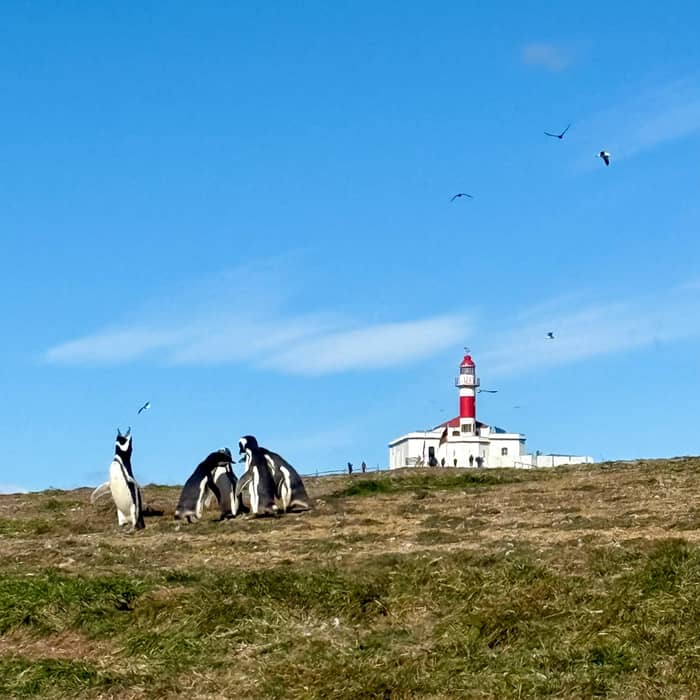
Magellanic
Magdalena Island
Strait of Magellan, Chile
- PairsAbout 7,000
- SeasonOctober to mid-April
- VisitGuided, 1 hour
Choose your stop
The quick take
The Magellanic penguins of Magdalena Island are Spheniscus magellanicus, a South American penguin with a double black chest band that breeds through the Patagonian summer and spends the winter at sea as far north as Brazil and Peru.
Species facts
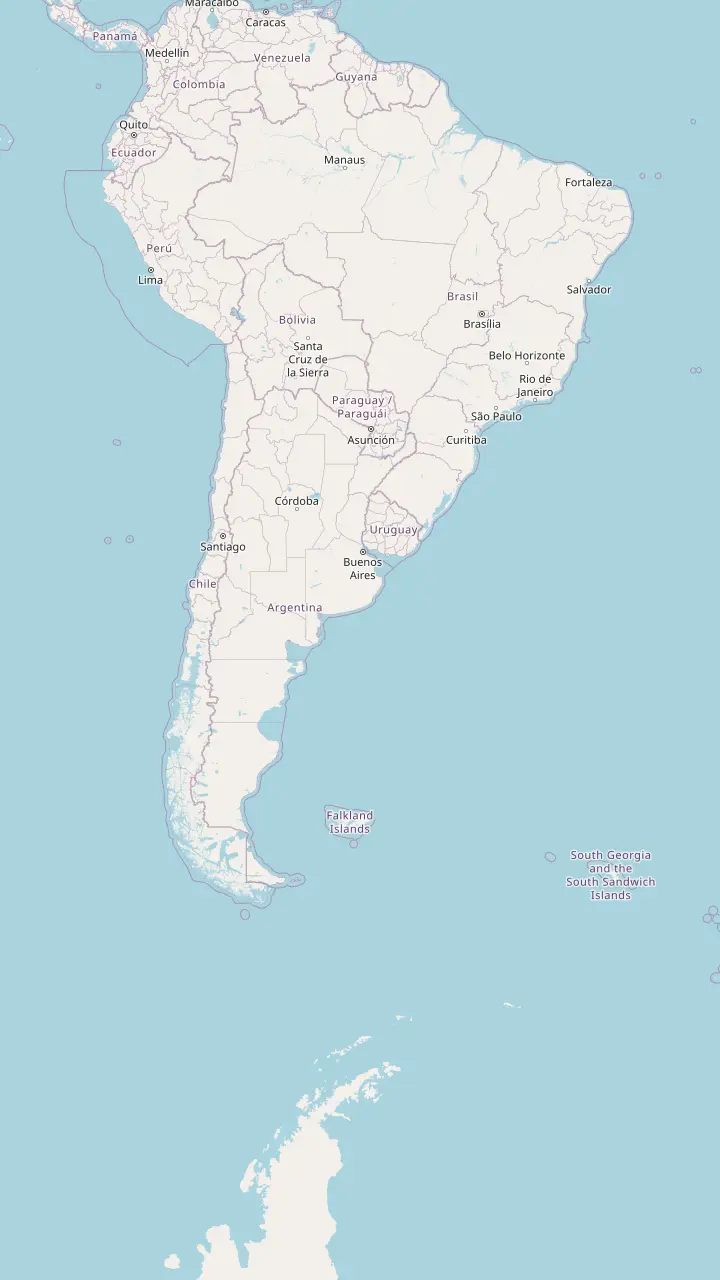
Map of 19 stops
Tap a route first, then a pin or stop, for its note and Google Maps.
The lighthouse of 1902 that crowns the island walk; rangers keep an exhibition in the old keeper's house.
Google MapsReserve whose islands hold 1,600 pairs on Isla de los Estados and 105,500 on Isla Observatorio.
Google MapsArgentine national park whose colony counts more than 40,000 pairs.
Google MapsArgentine marine park with 13 colonies and 60,000 pairs of Magellanic penguins.
Google MapsChubut reserve that protects the leading mainland colony of the species.
Google MapsRio de Janeiro beach where a young Magellanic penguin was filmed swimming, inside the species' known range.
Google MapsIslets off Chiloé where Magellanic and Humboldt penguins both nest.
Google MapsThe one island of Chile's Humboldt penguin reserve with a trail to see the birds; the Humboldt penguin wears a single chest band.
Google Maps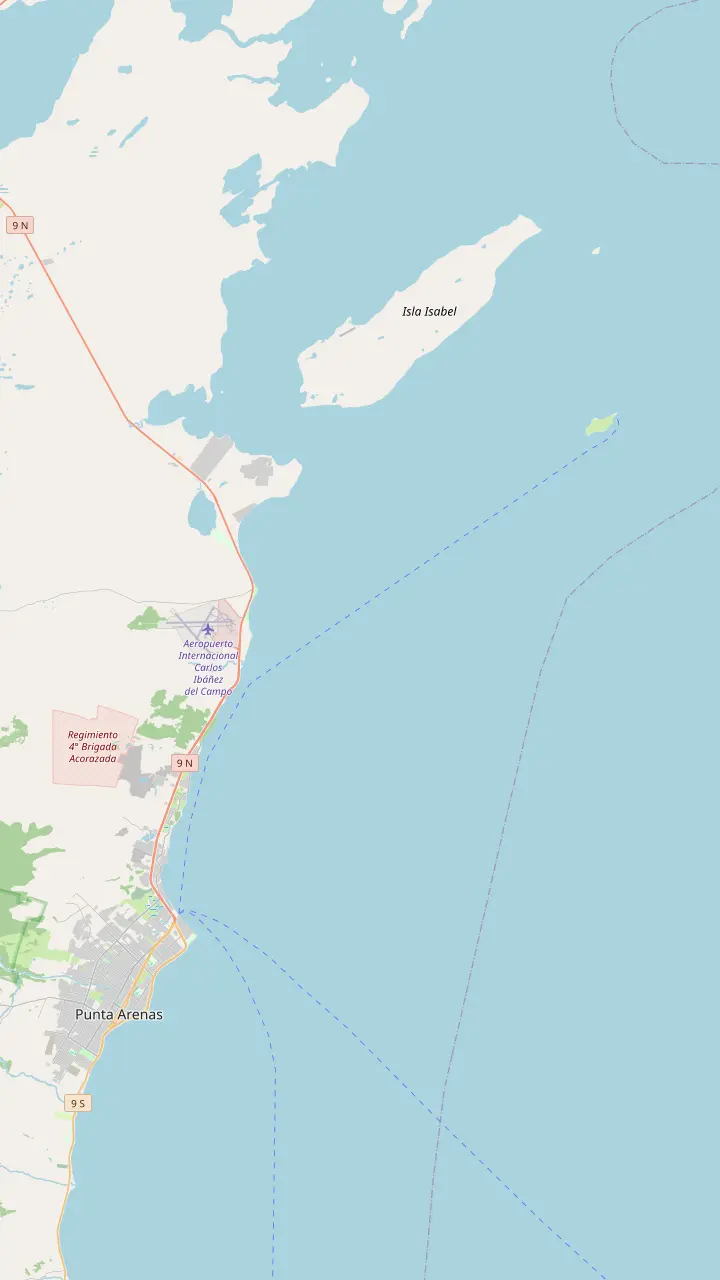
The lighthouse of 1902 that crowns the island walk; rangers keep an exhibition in the old keeper's house.
Google MapsBreeding ground of imperial cormorants and sea lions; landing is banned, so you watch from the boat.
Google MapsThe cape on the mainland that the two islands face, the cape the two islands face; the islands lie 35 km northeast of Punta Arenas.
Google MapsWhere the site tour's speedboat leaves for the islands, after a coach ride of 30 minutes.
Google MapsThe other city pier Sernatur lists for boats to the islands.
Google MapsPunta Arenas pier named by Sernatur as a departure point for boats to the monument.
Google MapsWhere the site tour finishes after the return coach ride.
Google Maps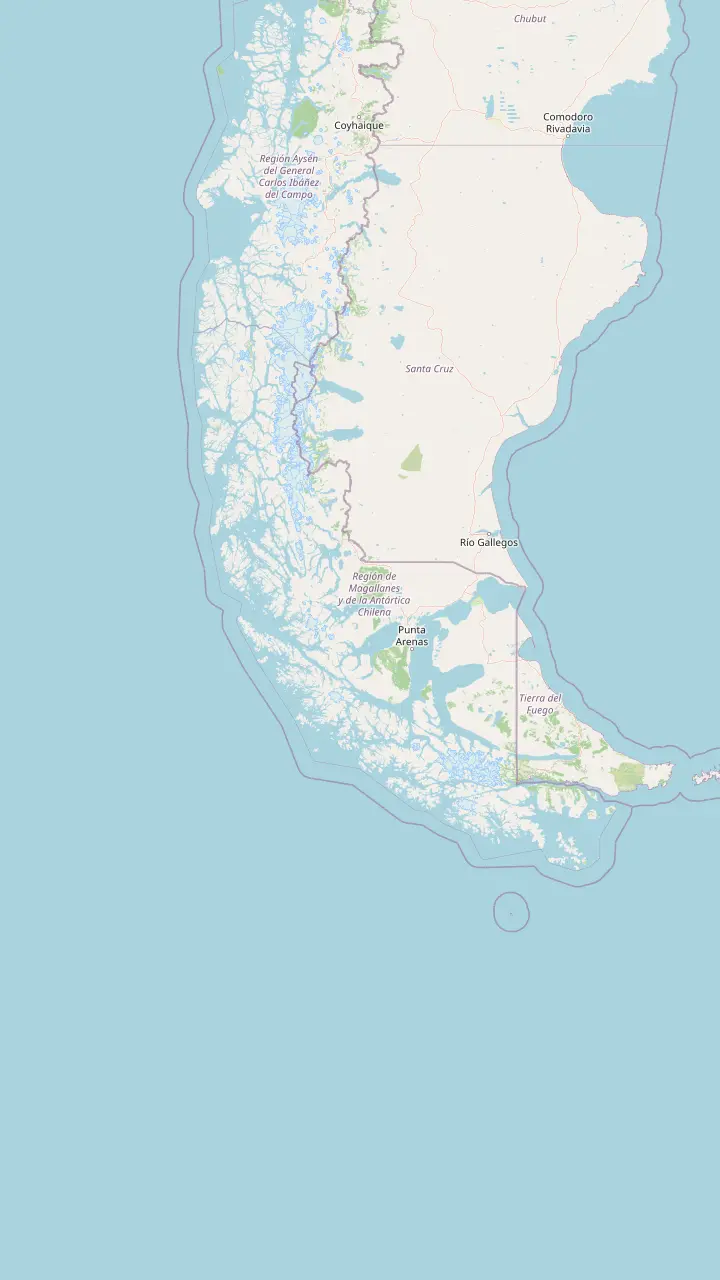
The lighthouse of 1902 that crowns the island walk; rangers keep an exhibition in the old keeper's house.
Google MapsThe first light raised in the Strait area, lit in September 1896 at the western mouth.
Google MapsA cast-iron tower of 14 metres near the Pacific end of the Strait, still run by the Navy.
Google MapsA low light of 1904 that guided ships toward Punta Arenas; today it is lodging.
Google MapsA metal tower of 15 metres from 1901 on the First Narrows, never left without keepers.
Google MapsStone tower of 11 metres built between 1897 and 1900, automated in 1955.
Google MapsPunta Arenas pier named by Sernatur as a departure point for boats to the monument.
Google MapsMapping data © OpenStreetMap contributors
Before you walk among them, get to know the bird itself: the double chest band, the summer on the nest, the long swim north for winter and the relatives that live as far away as the Equator.
Editorial team, magdalenaislandtour.com · Updated November 12, 2026 · Reading: 8 min
Key facts
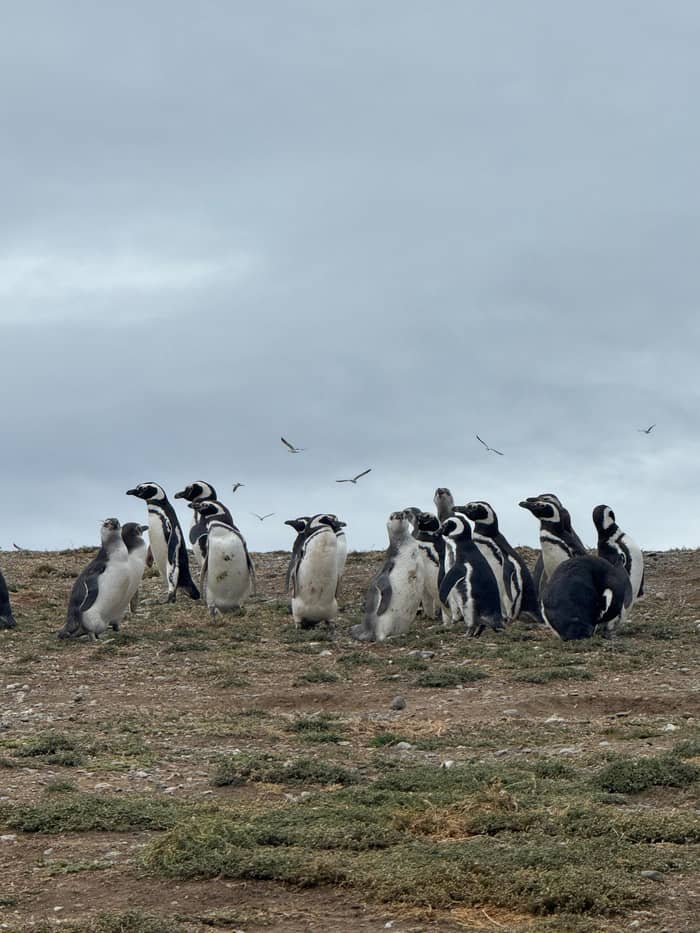
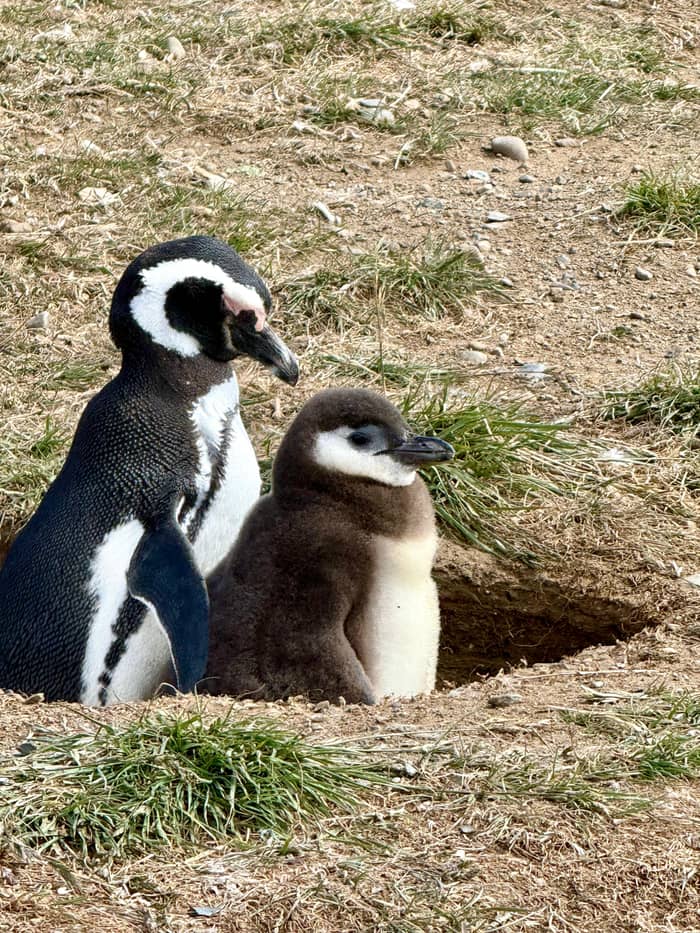
The Magellanic penguins of Magdalena Island belong to the species Spheniscus magellanicus, and CONAF counts about 7,000 pairs nesting on the island.1 Chile's environment ministry notes that the species is also known as the Patagonian penguin, a fair name for a bird whose life is tied to the coasts at the bottom of the continent.2 Spend an hour with them and you will see them standing at burrow mouths, waddling to the shore and calling across the colony.
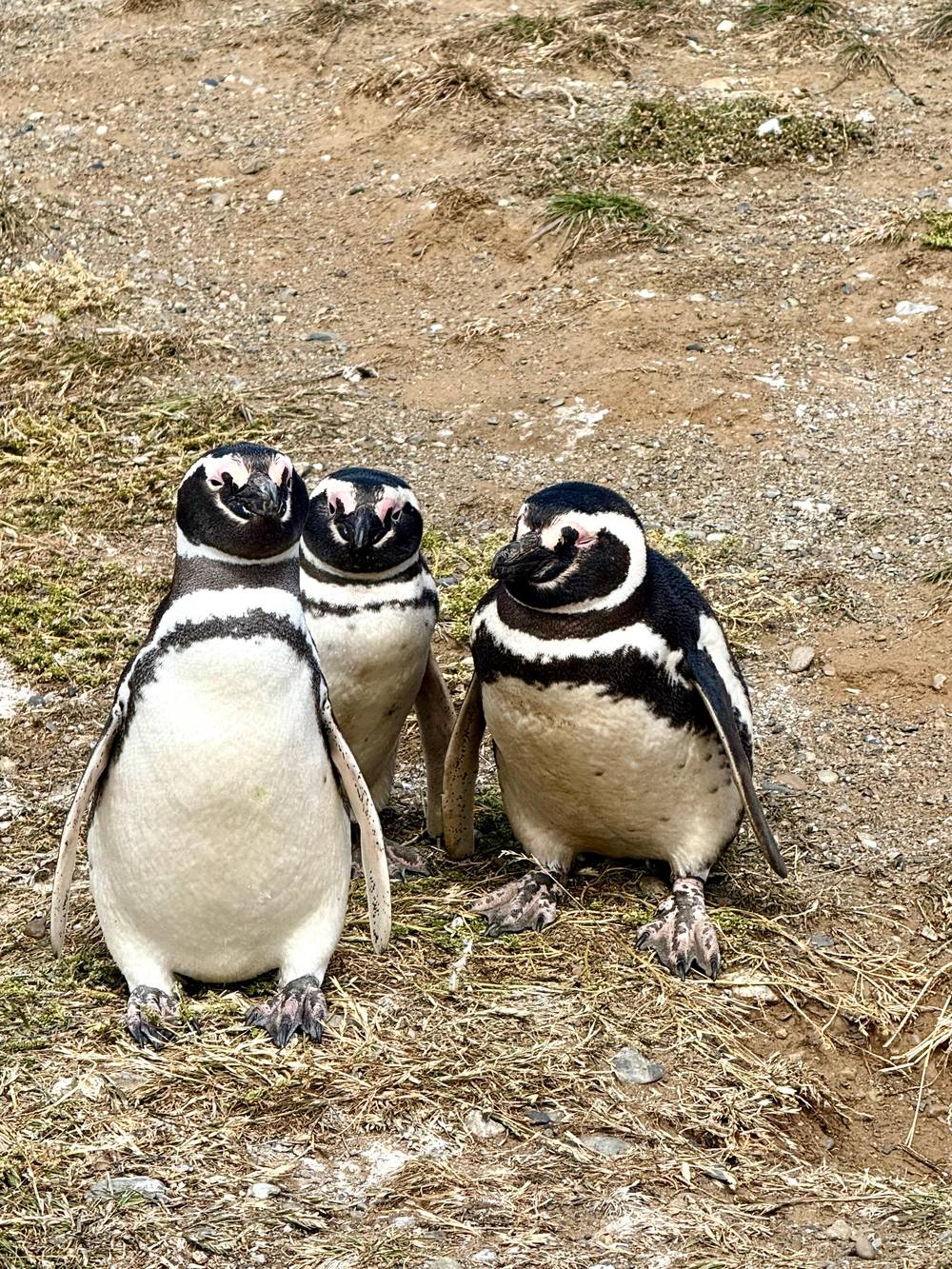
The quickest way to recognise one is the chest. Sernatur explains that the Magellanic penguin is told apart from its Humboldt relative by having 2 black lines across its chest instead of one.3 The Humboldt penguin, by contrast, wears a single black band in the shape of an inverted U across its white chest.7 Once you have spotted the double band on the first few birds near the landing, you will pick it out instantly on every adult along the trail.
Magellanic penguins on Magdalena Island in Chile are only part of a much wider population. The ministry describes it as one of the most widely distributed penguins, seen from Atacama in Chile on the Pacific to southern Brazil on the Atlantic.8 In Chile it breeds mainly in the south, from the Valparaíso Region southward, while Argentina holds the great Atlantic colonies.9 The map on this page shows the island against that range.
Spheniscus penguins
| Penguin | Where it breeds | Field mark | Status |
|---|---|---|---|
| Magellanic | Southern Chile and Argentina | Double black chest band | Near Threatened (IUCN) |
| Humboldt | Northern Peru to Chiloé | Single inverted U on the chest | Proposed Endangered in Chile |
| Galapagos | On the Equator | Small, about 35 cm tall | Threatened (IUCN) |
From Chile's environment ministry, CONAF, Sernatur, Ecuador's Galapagos National Park and Argentina's biodiversity system.9,3,6,22,7,23,19,24
The best-documented calendar for the species comes from the Atlantic coast, where Chile's environment ministry puts the breeding cycle from early September to mid-April.4 Chubut, the Argentine province where Punta Tombo lies, sets out the sequence. Males land first and reclaim the burrow they used before to get it ready, and the females turn up some weeks afterwards, form pairs and usually produce 2 eggs.10,12
At Punta Tombo the province sums up the season as arrival in September, eggs laid in October, chicks hatching in November, then growth and migration in April.11 Over the following weeks the young fatten up and learn to fend for themselves, while the adults renew their feathers during the warm months, the province notes.13,14 Once late March and April arrive, the province says, the entire colony sets off northwards on a journey of thousands of kilometres through Atlantic waters, following food.13
Magdalena sits much further south than Punta Tombo, so treat those dates as the species' rhythm rather than a timetable for the island. The island itself is open to landings only in the warm months, and CONAF's calendar for the next summer starts on 15 October 2026 and stops on 31 March 2027.16,17 Sernatur steers penguin watchers towards the October to March stretch, tying it to the breeding cycle.18 Our season page follows the island month by month.
When breeding ends, the colony empties. Chile's environment ministry explains that every winter the species migrates north towards warmer waters, reaching southern Brazil on the Atlantic and even southern Peru on the Pacific.5 On migration the birds are generally found swimming tens of kilometres offshore, so few people ever see them on the journey.15 The island's visiting season ends before winter, and the birds you meet in January spend the cold months at sea.
Now and then a migrant turns up close to shore. The ministry once explained a video of a Magellanic penguin swimming at Arpoador beach in Rio de Janeiro, and identified it as a juvenile in good condition.30,31 Its point was that Rio de Janeiro state lies within the species' known range, so the bird was not lost, simply far up its normal path.32 Look at the range panel of the map to see how far that is from the Strait of Magellan.
The ministry also notes that species have lately been recorded outside their historic ranges, partly because more people are watching and partly because conditions are changing.33 For a visitor that means sightings far from the colonies are worth reporting rather than rescuing. If you find a penguin injured or struggling on a beach, the ministry asks you to alert Sernapesca, the competent authority, and to keep pets away from it.34
Your penguin plans
Let the sight you care about most pick the place.
If I want to walk among Magellanic penguins
Magdalena Island in summer
Visits run from October to mid-April with certified guides.16,25
If I want to compare species
The Puñihuil islets off Chiloé
Both Magellanic and Humboldt penguins nest there.26
If I want the biggest colony
Punta Tombo in Argentina
Its zone holds 180,000 pairs; the season runs mid-September to mid-April.27,28
If I want penguins near the Equator
The Galapagos Islands
The Galapagos penguin lives and nests on the Equator.19
If I am in Patagonia in winter
Plan for another season
The birds migrate north and spend winter at sea.5
Where to meet them
Magellanic
Strait of Magellan, Chile
Both species
Chiloé, Chile
Mainland colony
Chubut, Argentina
Penguins are hunters of the sea. Argentina's national parks administration says that, depending on species and place, penguin diets are made up of crustaceans and squid.63 CONAF, writing about penguins in Chile, describes them as excellent swimmers that feed mainly on fish, crustaceans and squid.64 Every adult you see waddling up from the beach on Magdalena has just come back from that kind of fishing trip, often with food for a chick.
CONAF's rules for the island reflect this traffic. Near the landing, along roughly the first 300 metres of path, CONAF expects a stream of parents hauling meals inland, and asks walkers to give way and never startle a bird into bringing its catch back up.60 Stand still and let them through. A parent that drops its load to escape a crowd has wasted a long swim, and the chick waiting in the burrow pays for it.
The penguins have enemies on both sides of the shoreline. At sea the danger is orcas and seals; ashore it is skuas and giant petrels, by Sernatur's account.29 Argentina's biodiversity system notes that the South American sea lion, a breeder on nearby Isla Marta, lives mainly on fish, squid and crustaceans yet sometimes catches penguins.65,38 The colony you walk through is busy, noisy and, for the birds, never entirely safe.
The Magellanic penguin has close relatives in the same genus, Spheniscus, and Chile hosts one of them. The Humboldt penguin, Spheniscus humboldti, is endemic to the Humboldt Current, and Chile's Council of Ministers has declared it a species Natural Monument.66 Its range runs from northern Peru to Chiloé, and CONAF reports that the 2017 national census found 38 breeding colonies and 5,067 breeding pairs in Chile.22,67
The Humboldt penguin is in trouble. CONAF cites an ongoing study warning that since 2021 Chile's breeding population has dropped below 3,000 pairs, and the environment ministry says its status was proposed to rise from Vulnerable to Endangered.68,23 The Magellanic and Humboldt penguins meet at the Puñihuil islets off Chiloé, which CONAF counts among the rare spots on Earth where Magellanic and Humboldt penguins both raise their young.26
The smallest cousin lives on the Equator. Ecuador's Galapagos National Park says the Galapagos penguin, Spheniscus mendiculus, is the only species that lives and nests on the Equator, and one of the smallest, averaging 35 cm tall.19 A census on Isabela, Fernandina and the Las Marielas islets counted 413 of them, and the park says 96% of those recorded were adults, which it read as a drop in breeding, probably from scarce food.69,70,71
Video
James Wolfe on YouTube · Video data is requested only when you tap play.
The main natural predators of penguins are orcas and seals in the sea, and skuas and giant petrels on land.
Field marks
Argentina's biodiversity system lists the Magellanic penguin as Near Threatened on the IUCN Red List, and Argentina's own 2017 national bird categorisation lists it as Vulnerable.6,72 Large protected colonies help. Argentina's parks administration counts more than 40,000 pairs at Monte León and 60,000 pairs across 13 colonies in the Isla Pingüino marine park.57,56 On the Chilean side, Magdalena's colony sits inside a natural monument.73
Oil was once the great killer. An Argentine penguin scientist told the government portal that in the 1980s about 40,000 penguins were found dead from oil each year in Chubut, and that today no more than 20 a year are.74 In 1991 a large spill in southern Argentina affected 17,000 penguins, and afterwards tanker routes were moved away from the coast.75,76 It is one of the clearest conservation wins along this coast.
The pressures today are harder to steer. The same scientist named climate change, commercial fishing and marine pollution, once oil and now plastic, as the main threats.77 Bird flu has added a new risk: CONAF's page for the monument warns of an avian influenza outbreak in Chile.78 The Magellanic penguins of Magdalena Island look plentiful when you are surrounded by them, but the numbers that matter are measured over decades, not one visit.
If your trip takes in more than one colony, a few field marks help, and they work at a distance, from a boat or along a marked trail, without bothering the birds. Magellanic penguins carry 2 black chest lines, while the Humboldt penguin wears a single inverted U across a white chest.3,7 King penguins, which you can also see in Chilean Tierra del Fuego, are far bigger at 94 cm and show orange on the upper chest, the sides of the head and a line on the beak.20,79
Size is the other clue. The Galapagos penguin averages 35 cm tall, while the emperor, the largest penguin in the world, averages 1.20 m in height by Sernatur's figure.19,21 The Magellanic penguin sits between those extremes, and Sernatur notes it is often mistaken for its Humboldt relative because of their similar size.3 Use the chest bands, not the height, to tell them apart, especially on a windy beach where every bird is hunched against the weather.
Counting species is less tidy than you might expect. CONAF's Humboldt article and Sernatur both count 9 penguin species in Chile out of 18 worldwide, while CONAF's page for the Puñihuil islets gives 17 species worldwide, 9 of them in Chile.80,81,82 Either way, Chile hosts about half the world's penguins by species, and the Magellanic penguin is the one most visitors to Patagonia meet up close.
FAQ
It has 2 black lines across the chest; the Humboldt penguin has one.3
Ecuador's park says it is the only species living and nesting on the Equator, averaging 35 cm tall.19
At Punta Tombo the females generally lay 2 eggs, weeks after the males return.12
Orcas and seals at sea, skuas and giant petrels on land, says Sernatur.29
Sources
Further reading
Penguins in the Strait of Magellan? Ask a real person.